
Termination and Severance in Poland: A Complete Guide to Employment Law
The Polish Labor Code provides exceptionally strong protections for employees, making unjustified or structurally flawed dismissals highly vulnerable to labor court lawsuits. That’s why navigating employment law in Poland during the termination of a contract requires extreme caution and procedural precision.
Employers must strictly observe statutory notice periods, formal justification requirements, and specific trade union consultation rules. Furthermore, protecting corporate trade secrets post-employment demands the execution of highly specific non-compete agreements.
This guide details the legal mechanics of firing personnel, calculating severance, and securing intellectual assets upon an employee’s departure.
How can an employment contract be legally terminated in Poland?
Polish labor regulations clearly define the acceptable mechanisms for dissolving a professional employment relationship.
Termination by mutual agreement (Rozwiązanie za porozumieniem stron)
The safest and most flexible method is termination by mutual agreement, where both parties freely dictate the end date without waiting for statutory deadlines. This method generally waives the risk of future labor court disputes.
Termination with standard notice (Rozwiązanie za wypowiedzeniem)
When mutual consent is not possible, contracts are terminated with standard notice. If an employer terminates an indefinite-term contract, they are strictly legally required to provide a written, concrete, and real justification for the dismissal, and the employee has the right to appeal to a labor court within 21 days.
Disciplinary termination without notice (Rozwiązanie bez wypowiedzenia / dyscyplinarne)
In cases of severe employee misconduct, such as drinking on the job or stealing corporate data, the employer can utilize a disciplinary termination without notice (firing with immediate effect). This requires adhering to strict procedural rules and timing, usually within one month of discovering the cause.
What are the statutory notice periods for employees?
When an employer or employee decides to end the contract unilaterally with standard notice, the transition timeline is dictated directly by the law. Notice periods in Poland are scaled progressively and depend entirely on the type of contract and the total duration of the employee’s tenure with that specific employer. These periods cannot be shortened unless via mutual consent.
Probationary Contract Notice Periods
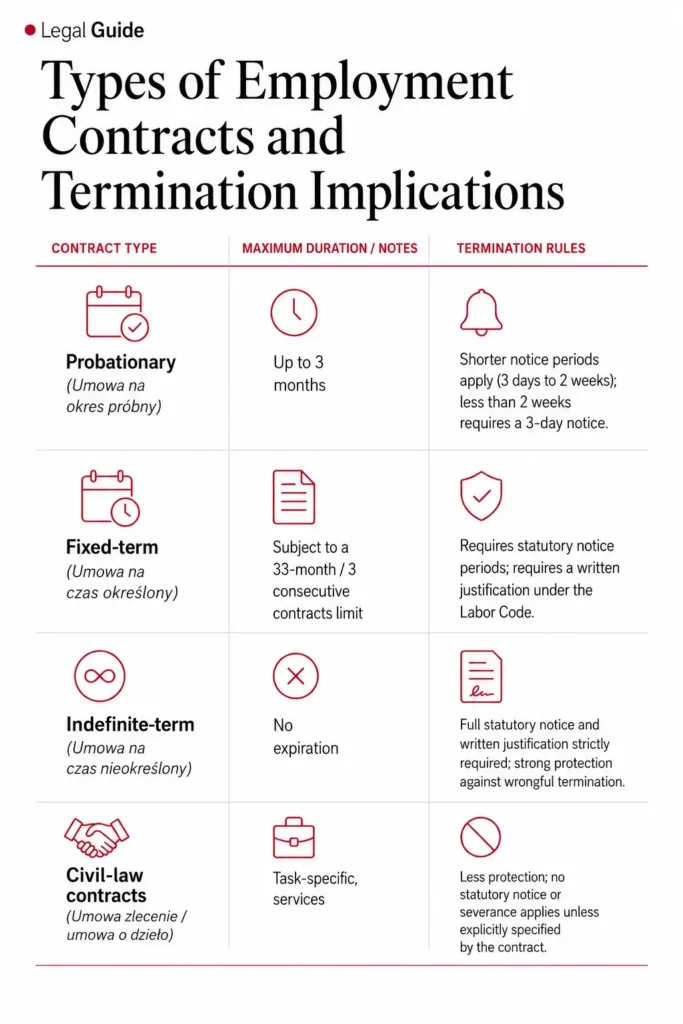
For probationary contracts (umowa na okres próbny), shorter statutory notice periods apply, ranging from 3 days to 2 weeks. Specifically, a 3-day notice period applies if the probationary employment at the company is less than 2 weeks.
2 Weeks’ Notice Period
A statutory notice period of 2 weeks applies to standard fixed-term or indefinite-term contracts when an employee has worked for the specific company for less than 6 months.
1 Month’s Notice Period
A statutory notice period of 1 month applies to standard fixed-term or indefinite-term contracts when the employee has been employed by the specific company for at least 6 months but less than 3 years.
3 Months’ Notice Period
A statutory notice period of 3 months applies to standard fixed-term or indefinite-term contracts when the employee has been securely employed by the specific company for 3 years or longer.
Types of Employment Contracts and Termination Implications
When is severance pay strictly required by law in Poland?
Statutory severance pay is only mandated when the termination occurs entirely for reasons unrelated to the employee (such as economic redundancies, downsizing, or corporate restructuring). Crucially, this obligation applies exclusively to companies that employ at least 20 workers.
Financial compensation upon termination is not an automatic right for every dismissed worker in Poland. If a company falls under this threshold, the employer must pay a specific multiplier of the employee’s monthly salary. The severance amount scales from one to three months of pay, depending on how long the dismissed employee served the corporation. If an employee is fired for disciplinary reasons or underperforms, no statutory severance is owed.
How do post-employment non-compete agreements work?
Polish law dictates that the employer must pay the former employee monthly compensation equal to at least 25% of their previous base salary for the entire duration of the non-compete restriction.
Protecting corporate clients and sensitive operational data after an employee departs requires a separate legal instrument. To prevent an ex-employee from working for a direct rival, the company must sign a dedicated post-employment non-compete agreement (NCA). This document explicitly details the restricted market sectors and geographic zones. Unlike non-competes active during employment, post-employment restrictions are not free for the employer. If the employer misses a compensation payment, the non-compete ban automatically becomes legally void.
Termination and Severance in Poland – FAQ
Can I fire an employee without notice?
Yes, but only under severe disciplinary circumstances, such as committing a crime, extreme negligence, or arriving at work under the influence of alcohol.
Do I need a reason to terminate a contract?
If terminating a permanent (indefinite) contract with notice, the employer must provide a genuine, concrete, and written justification for the dismissal.
Are notice periods negotiable in Poland?
Standard statutory notice periods cannot be unilaterally shortened, but both parties can agree to an immediate departure via a mutual termination agreement.
Who qualifies for statutory severance pay?
Employees dismissed solely for employer-related reasons (e.g., downsizing or organizational restructuring) qualify, provided the employing company has 20 or more staff members.
Can I enforce a free post-employment non-compete?
No, restricting a former employee from working for a competitor requires paying them at least 25% of their prior salary for the entire duration of the restriction period.
What happens to unused annual leave upon termination in Poland?
If an employee has unused statutory annual leave at the time of contract termination, the employer must either allow the employee to use the remaining days during the notice period or pay a financial equivalent (unused leave allowance) for each unused day.
Can you terminate a pregnant employee in Poland?
No, under the Polish Labor Code, pregnant employees and those on maternity leave are strictly protected from dismissal. An employer cannot terminate their contract or give notice during this period, except in extreme disciplinary cases (termination without notice) or if the company declares bankruptcy.
Recommended institutions

Company’s partner
Institution name
Company’s partner
Institution name
Company’s partner
Institution name
Company’s partner
Institution name
Company’s partner
Institution name
Company’s partner
Institution name
Recommended lawyers

Barrister | Managing Partner
Zbigniew
Lorem
READ MORE
Barrister | Managing Partner
Władysław
Ipsum
READ MORE
Barrister | Managing Partner
Mirosław
Lorem
READ MORE
Barrister | Managing Partner
Mirosław
Lorem
READ MORE