
Criminal Penalties in Poland
Foundational rules of the Polish Penal Code
Navigating criminal law in Poland requires a deep understanding of how offenses are legally classified from their inception to their conclusion. The Polish Penal Code meticulously differentiates between merely planning a prohibited act and successfully executing it. This precise classification directly influences the severity of the imposed penalties, which can range from minor fines to 25 years of imprisonment.
Furthermore, the state’s right to prosecute is not infinite; the law establishes strict limitation periods (statutes of limitations). This guide unpacks the stages of committing a crime, the penalty structure, and the timelines for prosecution under Polish law.
What are the recognized forms of committing a crime?
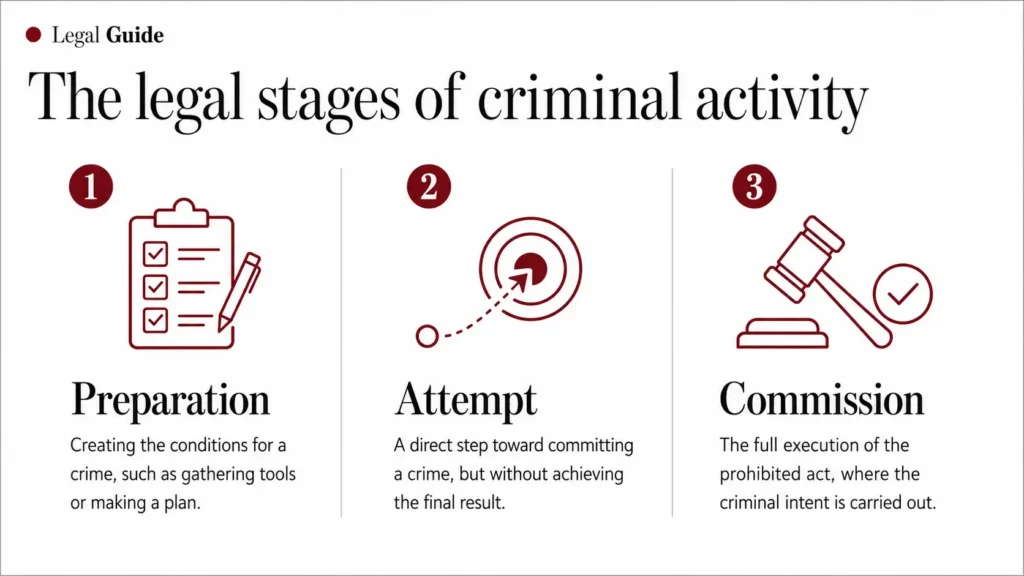
Under the Polish legal framework, a crime is not only punished when it is fully completed. The law distinguishes three primary stages of criminal activity: preparation, attempt, and final commission. Recognizing these stages is vital because the legal consequences differ significantly for each phase.
The legal stages of criminal activity:
● Preparation: This involves creating the conditions to commit a crime, such as gathering tools or making a specific plan. Usually, preparation is only punishable if specifically stated by a legal statute.
● Attempt: This occurs when the perpetrator directly acts toward committing the crime with intent, but the final outcome is not achieved.
● Commission: This is the full execution of the prohibited act, where the perpetrator successfully realizes their criminal intent.
What types of penalties exist under Polish law?
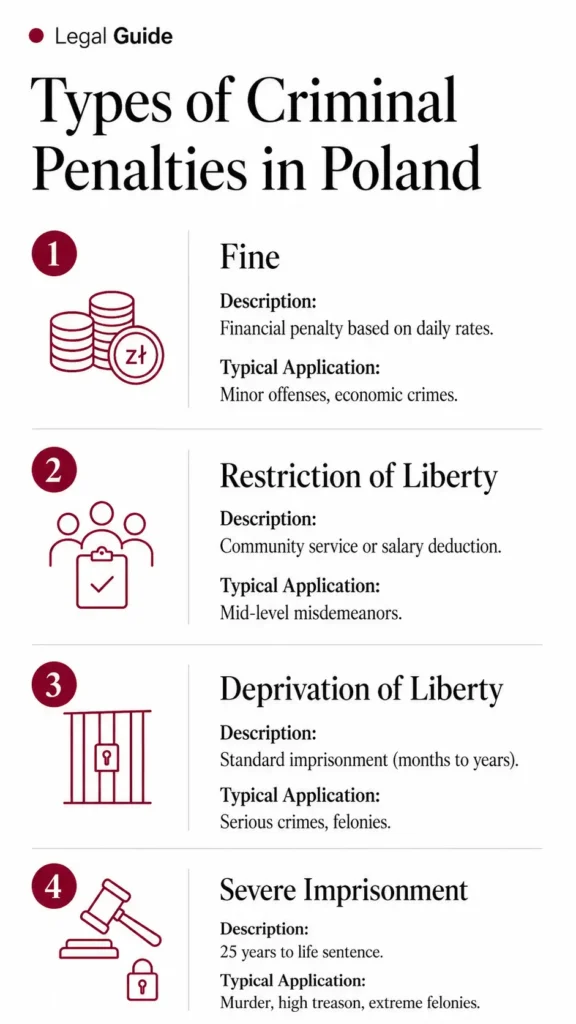
The penal system in Poland utilizes a catalog of penalties designed to match the social harm of the committed act. Judges have a wide array of sentencing options, starting with financial fines calculated based on daily rates, which reflect the offender’s income and financial status.
Mid-tier and custodial sentences
For more severe offenses, the court may impose a restriction of liberty, which often involves mandatory community service or deductions from the convict’s salary. The most severe form of punishment is the deprivation of liberty (imprisonment). Sentences can vary widely, but for the most heinous crimes, the Polish legal system allows for imprisonment of up to 25 years, and in extraordinary cases, a life sentence.
| Type of Penalty | Description | Typical Application |
| Fine | Financial penalty based on daily rates | Minor offenses, economic crimes |
| Restriction of Liberty | Community service or salary deduction | Mid-level misdemeanors |
| Deprivation of Liberty | Standard imprisonment (months to years) | Serious crimes, felonies |
| Severe Imprisonment | 25 years to life sentence | Murder, high treason, extreme felonies |
How long are the limitation periods for crimes in Poland?
The concept of a limitation period (statute of limitations) is a cornerstone of legal certainty. After a specified period of time has passed, the state permanently loses the right to prosecute an offender. The length of this period depends directly on the gravity of the crime and the potential maximum penalty assigned to it.
Statute of limitations for serious and minor offenses
For lesser crimes, the limitation period can be relatively short. However, for severe felonies, the limitation period extends for decades, ensuring that serious offenders cannot easily evade justice by simply hiding. It is also highly important to note that initiating legal proceedings against an individual automatically pauses or resets
these limitation periods, further extending the time the state has to secure a conviction.
“Accurately identifying the stage of an alleged crime—whether it was a mere preparation or an attempt—is crucial. Coupled with strict limitation periods, these technicalities often form the strongest foundation for an effective legal defense.” — Attorney at Dudkowiak & Putyra Law Firm
Criminal law in Poland – FAQ
Does attempting a crime carry criminal penalties in Poland?
● Yes, under the Polish Penal Code, directly attempting to commit a crime with clear intent is punishable, even if the final result is not successfully achieved.
What is the maximum prison sentence among criminal penalties in Poland?
● For the most severe felonies, courts can sentence an offender to 25 years of deprivation of liberty, and in exceptional cases, life imprisonment.
Can criminal penalties in Poland expire over time?
● Yes, Polish law includes limitation periods (statutes of limitations). Once this legally defined timeframe passes, the state can no longer initiate prosecution.
How does a restriction of liberty work under criminal penalties in Poland?
● It is a mid-tier penalty that does not involve jail time but typically mandates the offender to perform supervised, unpaid community service for a specific duration.
Recommended institutions

Company’s partner
Institution name
Company’s partner
Institution name
Company’s partner
Institution name
Company’s partner
Institution name
Company’s partner
Institution name
Company’s partner
Institution name
Recommended lawyers

Barrister | Managing Partner
Zbigniew
Lorem
READ MORE
Barrister | Managing Partner
Władysław
Ipsum
READ MORE
Barrister | Managing Partner
Mirosław
Lorem
READ MORE
Barrister | Managing Partner
Mirosław
Lorem
READ MORE