
Value Added Tax in Poland 2026: Rates and compliance
Value Added Tax in Poland applies to the payable supplies of goods and services within the territory of the country, exports outside the European Union, imports from non-EU countries, and intra-Community transactions. As of 2026, the Polish VAT system is highly digitized, built around a standard rate of 23%, and enforced through mandatory e-invoicing (KSeF) and unified electronic reporting (JPK_V7). For foreign investors and local enterprises alike, mastering these updated compliance rules, from the Split Payment Mechanism to objective exemptions, is essential for seamless market operations.
Executive Overview: VAT Rates & Compliance Tools (2026)
| Category | Key Details & Rates | Applicability |
| Standard Rate | 23% | The default rate for most goods and services. |
| Reduced Rates | 8% and 5% | Applied to specific food products, medical devices, books, and construction. |
Zero Rate 0% Exports, international transport, and intra-Community supply of goods (WDT).
| Exemptions | Subjective & Objective | Small businesses (under PLN 200k/year) and specific sectors (medical, financial). |
| Digital Compliance | KSeF & JPK_V7 | Mandatory electronic invoicing and unified tax reporting. |
| Split Payment | Mandatory over PLN 15,000 | For “sensitive” goods listed in Annex 15 of the VAT Act. |
What are the current rates of Value Added Tax in Poland?
Polish tax laws regarding VAT define specific rates depending on the type of goods or services provided, closely following EU directives while maintaining local annexes.
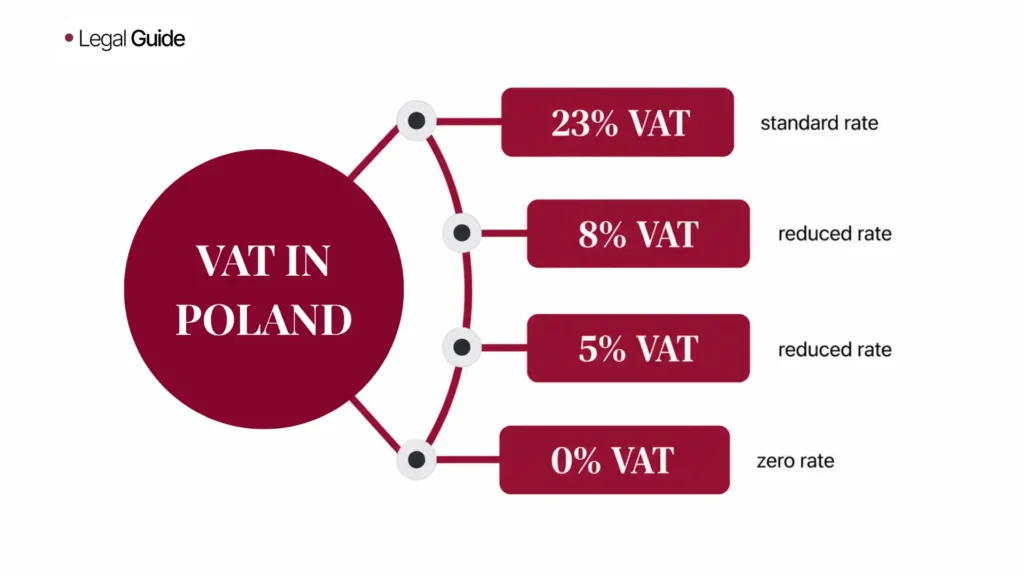
23% VAT (Standard Rate)
This is the basic, default rate applicable to all taxable goods and services not explicitly covered by reduced rates or exemptions.
8% VAT
Applied to goods and services listed in specific regulations, including residential construction and renovation (social housing), medical devices, cultural and sports services, passenger transport, and catering services (PKWiU 56).
5% VAT
Strictly applied to goods in Annex 10 of the VAT Act. This includes basic food products (like bread, meat, dairy, cereals), printed books, certain digital equivalents, and specific baby items or hygiene products.
0% VAT
Applies primarily to international trade, including the intra-Community supply of goods (WDT) and the export of goods outside the EU, allowing taxpayers to retain the right to deduct input VAT.
VAT Exemptions and Registration Rules
Not all businesses are required to charge VAT immediately. Poland distinguishes between two main types of exemptions:
Subjective Exemption (Revenue-Based)
Small businesses can benefit from a VAT exemption if their annual sales value in the previous tax year did not exceed PLN 200,000 (excluding the tax amount). Once this threshold is crossed, VAT registration becomes mandatory.
Objective Exemption (Service-Based)
Under Article 43 of the VAT Act, certain services are inherently exempt from VAT, regardless of revenue. These include medical services, educational services, and financial or banking operations. However, entities providing these services generally lose the right to deduct input VAT on their purchases.
Note on Registration: Any entity performing taxable activities in Poland that does not qualify for exemptions must register before their first taxable transaction by submitting the VAT-R form. Non-EU foreign businesses are generally required to appoint a fiscal representative in Poland.
KSeF, JPK_V7, and SPM: Digital Compliance 2026
Operating in Poland requires strict adherence to digital tax compliance systems.
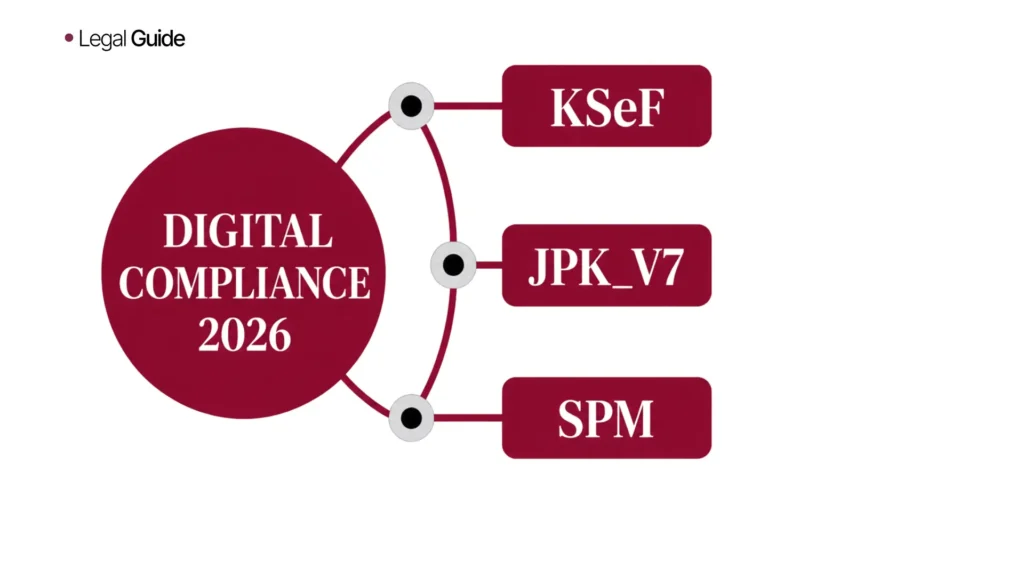
Mandatory e-Invoicing (KSeF) and JPK_V7
The Polish tax system requires all VAT taxpayers to issue and receive structured electronic invoices via the National e-Invoicing System (KSeF). Furthermore, taxpayers must file unified electronic returns combining their VAT declaration and audit files—submitted monthly (JPK_V7M) or quarterly (JPK_V7K) by the 25th day of the following month.
The VAT Split Payment Mechanism (SPM)
As a well-established rule in Polish tax law, the Split Payment Mechanism (MPP) requires that input VAT be allocated to a specific, dedicated VAT bank account, separate from the main operational account.
While businesses can use this voluntarily for any transaction, it is strictly obligatory for taxpayers who:
● Sell or purchase “sensitive” goods or services listed in Annex 15 to the Act on Value Added Tax (e.g., steel, precious metals, electronic integrated circuits, fuels, construction services, and car parts).
● Execute a transaction where the total invoice receivable (gross value) exceeds PLN 15,000.
FAQ About Value Added Tax in Poland
What are the specific rates for Value Added Tax in Poland?
The standard Value Added Tax in Poland is 23%. Preferential rates of 8% and 5% apply to specific categories like construction, medical devices, and basic food, while a 0% rate is applicable to international exports.
How do I register for Value Added Tax in Poland?
Registration requires submitting the official “VAT-R” tax form to the relevant Polish tax authority before conducting your first taxable transaction. Foreign businesses from outside the EU must also appoint a local tax representative and ensure their bank accounts are verified on the “White List” of VAT taxpayers.
Are VAT refunds fast in Poland?
The standard VAT refund time in Poland is 60 days. However, it can be extended up to 180 days if a company recorded no sales in a given period, or accelerated to 25 days if specific legal and banking conditions are met.
Is the establishment of a company subject to VAT?
No, the administrative establishment of a Polish company is not subject to Value Added Tax. Furthermore, the transfer of company shares is also exempt from VAT obligations.
Recommended institutions

Company’s partner
Institution name
Company’s partner
Institution name
Company’s partner
Institution name
Company’s partner
Institution name
Company’s partner
Institution name
Company’s partner
Institution name
Recommended lawyers

Barrister | Managing Partner
Zbigniew
Lorem
READ MORE
Barrister | Managing Partner
Władysław
Ipsum
READ MORE
Barrister | Managing Partner
Mirosław
Lorem
READ MORE
Barrister | Managing Partner
Mirosław
Lorem
READ MORE