
Patent Protection in Poland: Safeguarding your technical innovations
Securing technical solutions under Polish law
Patent protection in Poland provides crucial mechanisms to safeguard technical innovations and tangible assets. The legal framework governing intellectual property rights allows businesses to protect their investments, maintain a competitive edge, and enhance their brand value. When it comes to technical solutions, patents protect inventions that offer technical solutions to problems, while utility models cover simpler technical innovations.
What are the routes for patent protection in Poland?
The Polish patent system provides a structured legal framework that supports inventors in obtaining, maintaining, and enforcing their exclusive rights both nationally and internationally. Patent rights are territorial, meaning protection must be sought separately in different jurisdictions.
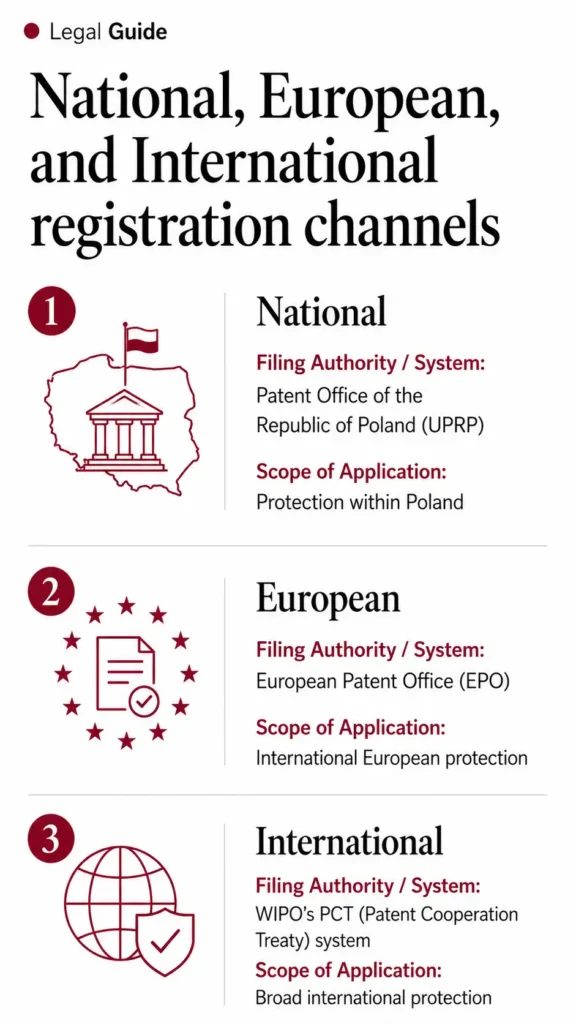
National, European, and International registration channels
Patent applications must be filed with the national office, or businesses can seek broader territorial protection using established international systems.
| Registrati on Route | Filing Authority / System | Scope of Application |
| National | Patent Office of the Republic of Poland (UPRP) | Protection within Poland |
| European | European Patent Office (EPO) | International European protection |
| Internatio nal | WIPO’s PCT (Patent Cooperation Treaty) system | Broad international protection |
How long does patent protection last in Poland?
Under Polish patent law, patent grants are issued for a limited period of 20 years from the filing date, provided that annual maintenance fees are paid. This duration aims to stimulate innovation and ensure that inventors benefit from legal exclusivity while contributing to technological progress.
Duration of utility models and non-patentable categories
Utility models offer a shorter protection period of 10 years. It is also crucial to note that some categories, such as business methods, mathematical algorithms, and natural discoveries, are not patentable under Polish law.
How can businesses enforce patent rights against infringement?
Patent infringement occurs when a third party uses, manufactures, or sells a patented invention without the consent of the patent owner. Protecting intellectual property is only effective if businesses actively enforce their rights against such violations.
Civil litigation and criminal sanctions
IP owners can file lawsuits in civil litigation for damages, injunctions, and the seizure of counterfeit goods. In cases of serious infringement, criminal charges may apply, leading to fines or imprisonment. Alternatively, mediation and arbitration offer a cost-effective and faster alternative to standard court proceedings.
FAQ: Navigating patent protection in Poland

What is the exact duration of a registered patent?
Patent grants are issued for a limited period of 20 years from the filing date, provided annual fees are paid.
Are utility models protected under Polish law?
Yes, utility models (sometimes called “small patents”) cover simpler technical innovations and offer a shorter protection period of 10 years.
What makes trade secrets different from patents?
Unlike patents, trade secrets are not registered and can be protected indefinitely, provided that proper safeguards such as confidentiality agreements are in place.
Who can help enforce exclusive IP rights?
Intellectual property lawyers support clients in protecting their IP assets and asserting exclusive rights, handling disputes related to patent infringement or intellectual property theft.
Recommended institutions

Company’s partner
Institution name
Company’s partner
Institution name
Company’s partner
Institution name
Company’s partner
Institution name
Company’s partner
Institution name
Company’s partner
Institution name
Recommended lawyers

Barrister | Managing Partner
Zbigniew
Lorem
READ MORE
Barrister | Managing Partner
Władysław
Ipsum
READ MORE
Barrister | Managing Partner
Mirosław
Lorem
READ MORE
Barrister | Managing Partner
Mirosław
Lorem
READ MORE